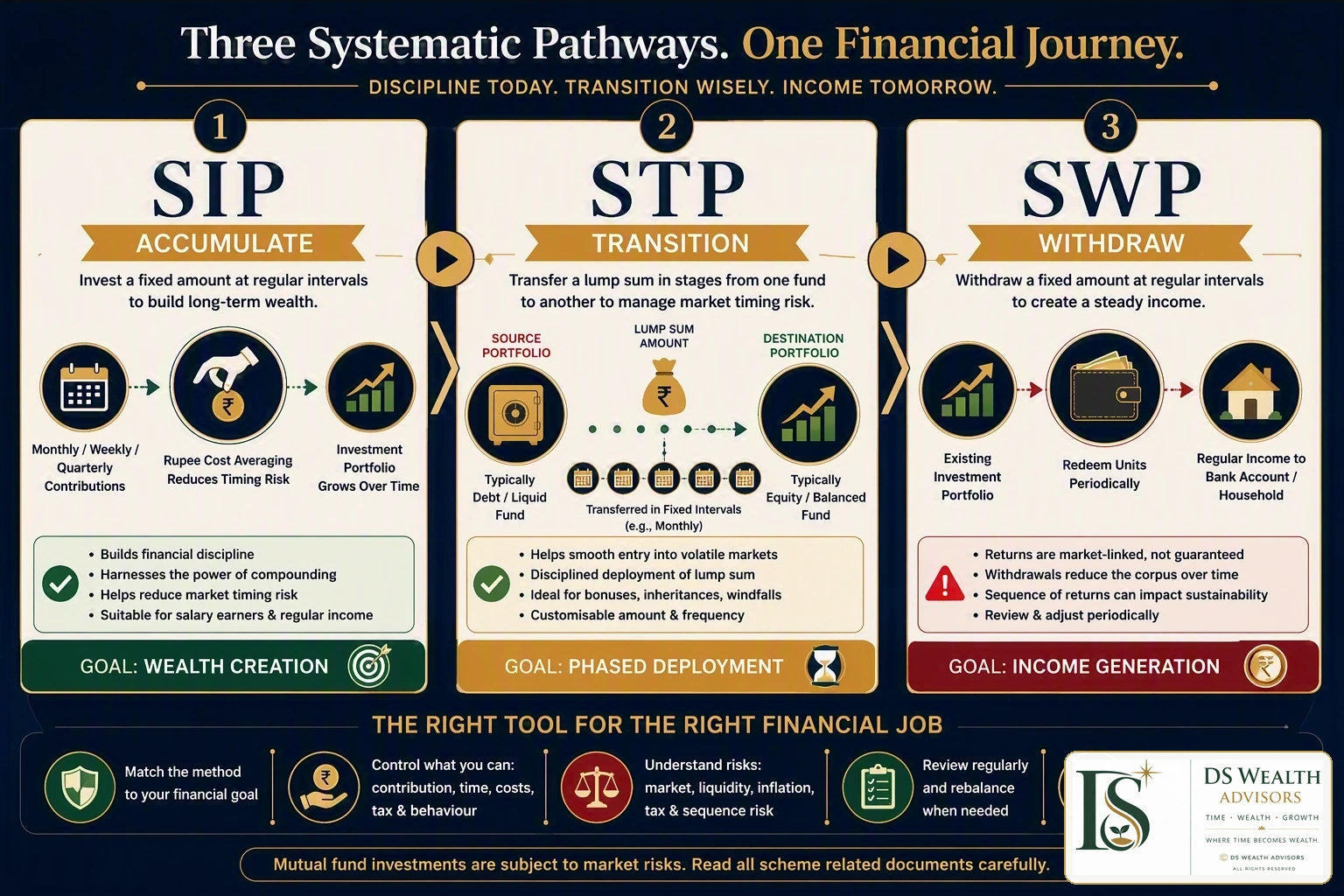
SIP (Systematic Investment Plan), STP (Systematic Transfer Plan) and SWP (Systematic Withdrawal Plan) are mutual-fund transaction instructions, not separate asset classes. SIP invests new money periodically, STP moves an existing amount between eligible schemes in stages, and SWP redeems units periodically to create cash flow. None guarantees returns or removes the risk of the underlying fund.
Choose the reading path that matches your decision
Start with mutual-fund basics, definitions, examples, the safety gate and FAQs.
Go to cost, tax, portfolio role, rebalancing, STP opportunity cost and sequence risk.
Focus on SWP mechanics, unit depletion, inflation and withdrawal stress testing.
A mutual fund is the vehicle; SIP, STP and SWP are instructions.
A mutual fund pools money from investors and invests according to a disclosed objective. The portfolio may hold equity, bonds, money-market instruments or a combination. Investors own units representing a proportionate interest. Net Asset Value (NAV) is the accounting value per unit after assets and liabilities are considered. An Asset Management Company (AMC) manages the scheme; the transaction instruction determines how money enters, moves or leaves, but the scheme determines investment exposure, cost and risk.
What is SIP? Systematic Investment Plan
SIP stands for Systematic Investment Plan. It is a facility through which a chosen amount is invested into a mutual fund at predetermined intervals. Each instalment purchases units at the applicable NAV. Lower NAV means the same contribution buys more units; higher NAV means it buys fewer. This is rupee-cost averaging in India and is functionally similar to dollar-cost averaging in the United States. It does not assure profit or protect against loss.
What is STP? Systematic Transfer Plan
STP stands for Systematic Transfer Plan. It periodically moves a chosen amount from a source mutual-fund scheme to an eligible destination scheme, usually within the same AMC. A transfer generally redeems source units and purchases destination units, so tax and exit load may apply. STP reduces dependence on one entry date but cannot guarantee a better average cost or higher return than immediate investment.
What is SWP? Systematic Withdrawal Plan
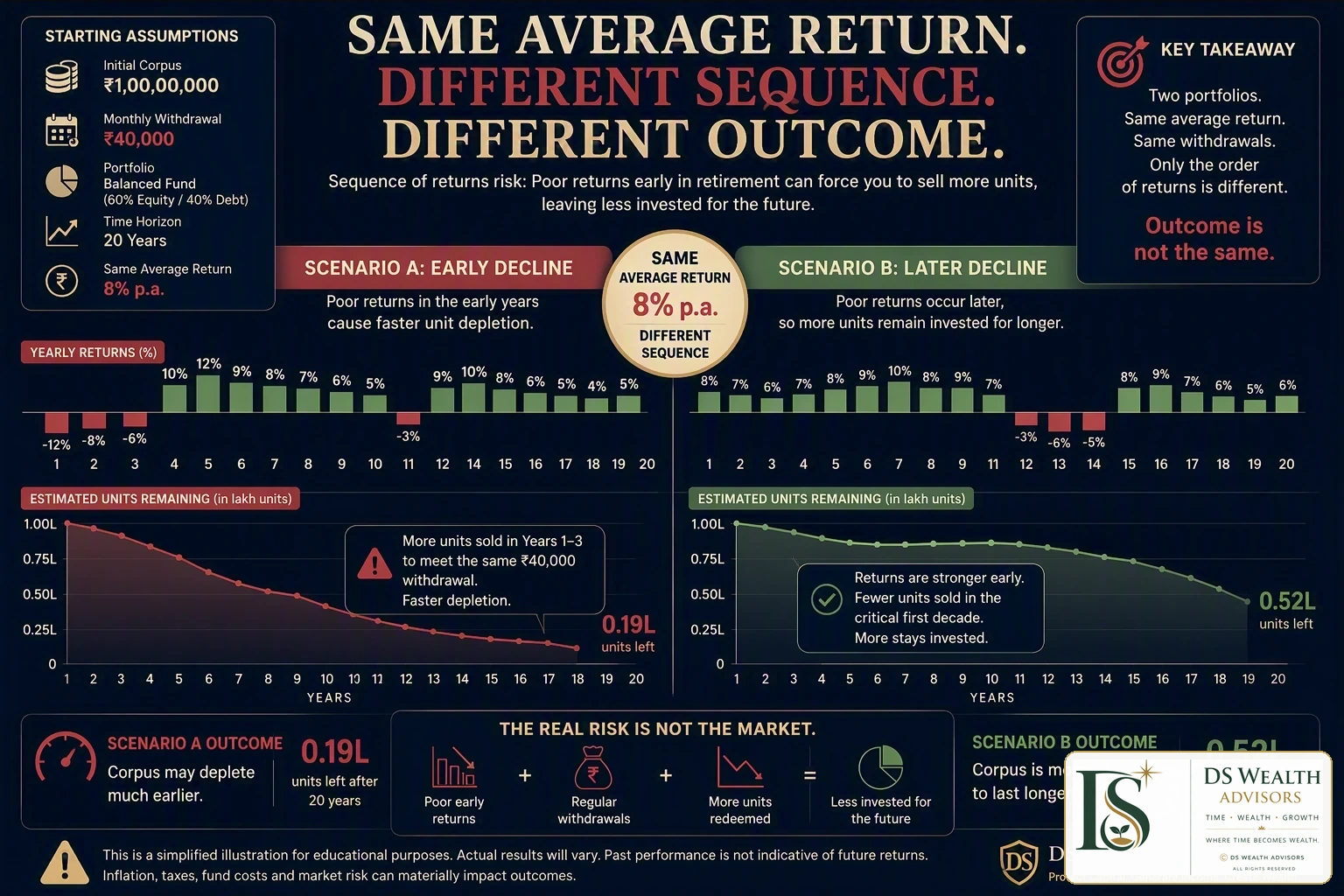
SWP stands for Systematic Withdrawal Plan. It periodically redeems units from an existing mutual-fund holding and pays the proceeds to the investor. The payment is not automatically interest, dividend or guaranteed income. It may include the investor’s own capital and gains. If withdrawals and losses persist, the corpus can be depleted.
| Feature | SIP | STP | SWP |
|---|---|---|---|
| Full form | Systematic Investment Plan | Systematic Transfer Plan | Systematic Withdrawal Plan |
| Primary job | Accumulate | Transition | Withdraw |
| Cash-flow direction | Bank account to mutual fund | Source scheme to destination scheme | Mutual fund to bank account |
| Unit effect | Purchases units | Redeems source units and purchases destination units | Redeems units |
| Main risk | Underlying-fund risk and stopping at the wrong time | Tax, exit load, source risk and opportunity cost | Sequence risk and corpus depletion |
| Return guarantee | None | None | None |
SIP buys, STP shifts and SWP sells. The instruction is systematic; the return is not.
Five questions for a first-time investor
Define the amount, date and whether the need is essential or flexible.
Short-horizon money may not belong in a volatile equity strategy.
Separate financial ability to absorb loss from emotional risk tolerance.
Choose a sustainable amount after essential spending, emergency liquidity and high-cost debt.
Read the objective, risk indicator, portfolio, costs, liquidity and exit conditions.
Do not choose a fund only because its recent return is high.
Experienced investors should evaluate the portfolio, not only the instruction
Classify the scheme as core exposure, income, diversification, liquidity or satellite allocation.
Compare expense ratio, advice or distribution cost, platform fee, exit load, tax and implementation friction.
Review concentration, drawdown, credit, duration, currency, liquidity and sequence risks.
Each contribution or redemption may have its own acquisition date, cost and holding period.
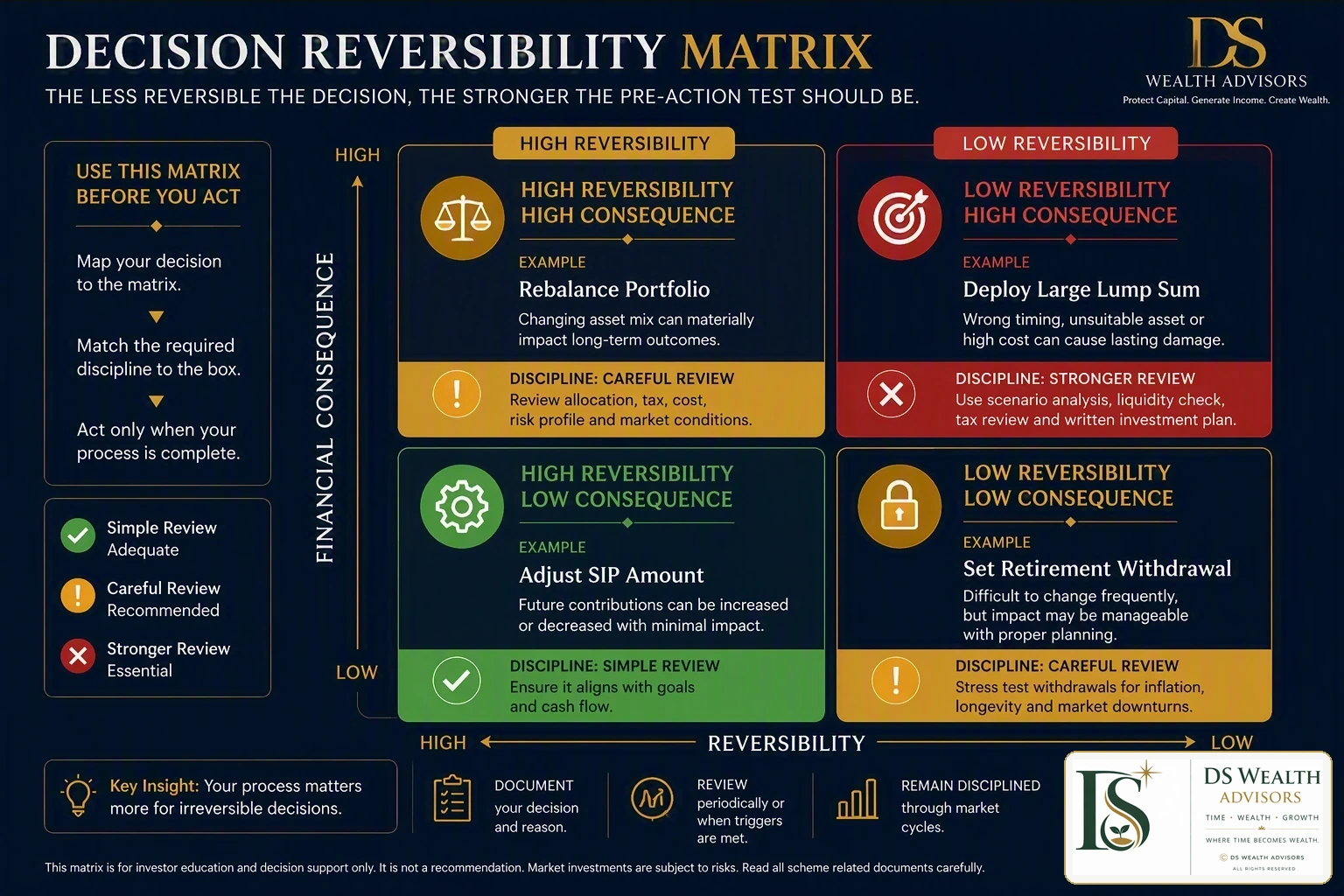
Define target bands and decision triggers before markets become emotional.
Document the thesis, expected role, review trigger and exit condition.
SIP, step-up SIP and cost-impact calculator
Assumptions / मान्यताएं: month-end contributions, monthly compounding, annual step-up after each 12-month block, fee deducted from gross return as a simplified scenario, tax and exit load excluded. Results are illustrations, not forecasts.

Outcome driver 1: contribution, time and suitable exposure create wealth
Future wealth = contributions + investment growth − fees − taxes − behavioural mistakes. Contribution and duration are more controllable than market return.
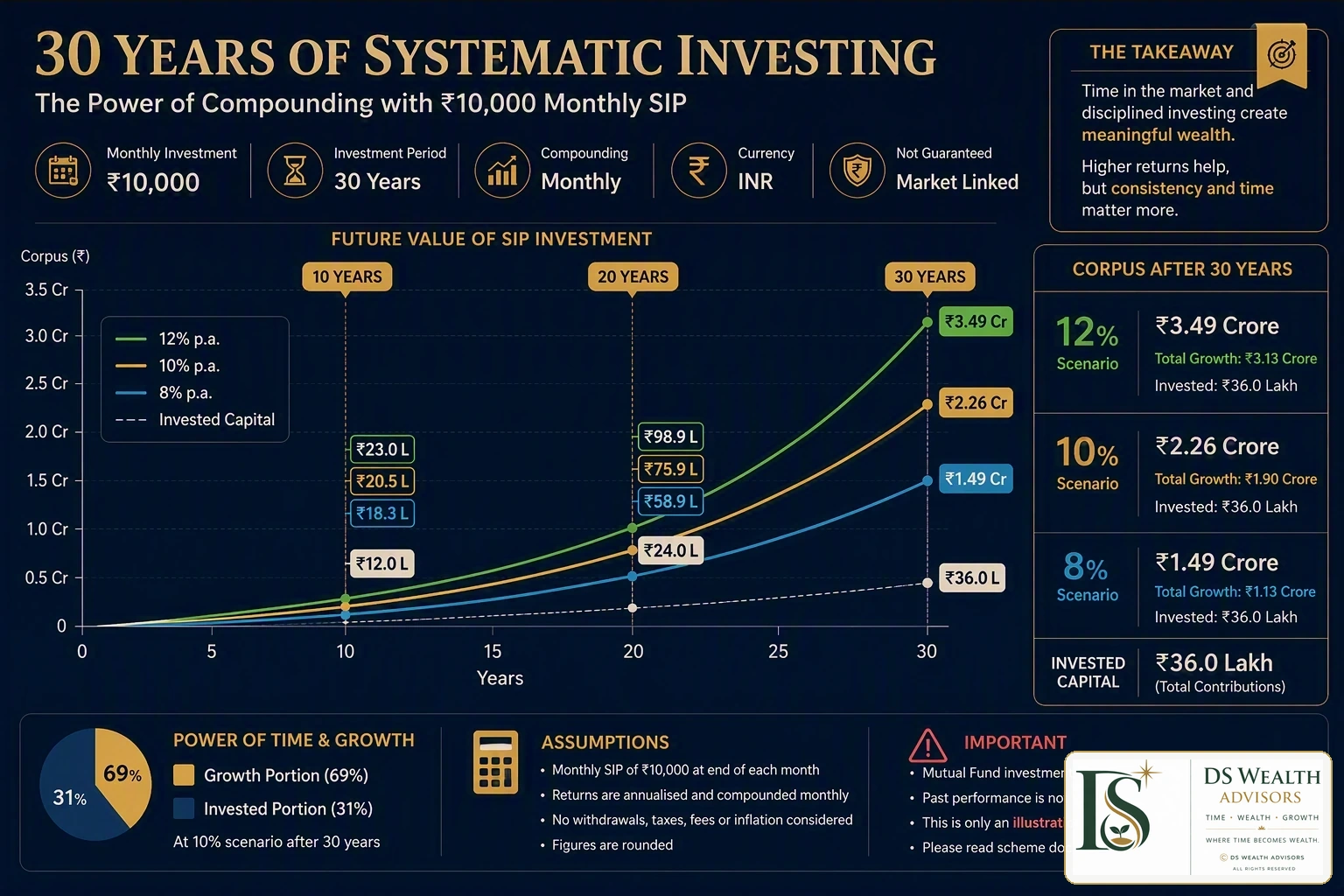
Time, contribution growth and cost all change the outcome
| Period | Contributed | 8% | 10% | 12% |
|---|---|---|---|---|
| 10 | ₹12.0 lakh | ₹18.29 lakh | ₹20.48 lakh | ₹23.00 lakh |
| 20 | ₹24.0 lakh | ₹58.90 lakh | ₹75.94 lakh | ₹98.93 lakh |
| 30 | ₹36.0 lakh | ₹1.49 crore | ₹2.26 crore | ₹3.49 crore |
Illustrative month-end contributions with monthly compounding; tax, costs and inflation excluded from this table.
Outcome driver 2: cost, tax and behaviour determine what the investor keeps
Compare post-cost, post-tax and inflation-adjusted wealth, not headline return alone.
Behavioural mistakes can overwhelm a sound instruction
Selecting the recent winner can mean buying after outperformance.
Stopping SIP after a fall can reverse the intended discipline.
Frequent switching can add tax, exit load and portfolio inconsistency.
A good review may lead to no transaction.
Outcome driver 3: match each instruction to the right financial job
Lifecycle example
₹15,000 monthly for a goal more than 12 years away; review contribution and asset allocation annually.
A ₹12 lakh bonus transferred at ₹1 lakh monthly after checking liquidity, tax, exit load and opportunity cost.
₹40,000 monthly retirement cash flow stress-tested for lower returns, higher inflation and an early market decline.

Before investing, pass five safety checks
Essential spending should not depend on selling a volatile investment at the wrong time.
Compare a certain borrowing cost with an uncertain investment return.
Confirm that the goal allows enough time for the selected risk.
A loss should not force abandonment of an essential goal.
Read the official documents before automating the transaction.
Four management tools improve the investment decision
The words change across markets; the economic job may remain similar
| Need | India | United States | United Kingdom | European Union |
|---|---|---|---|---|
| Invest periodically | SIP; rupee-cost averaging | Automatic investment; dollar-cost averaging | Regular investment; pound-cost averaging | Recurring investment or savings plan |
| Phase a lump sum | STP where supported | Scheduled exchanges or periodic purchases where supported | Phased investment where supported | Scheduled switching where supported |
| Withdraw periodically | SWP | Automatic or systematic withdrawals | Regular withdrawal or pension drawdown | Scheduled redemption or local drawdown arrangement |
Plain-language glossary
Frequently asked questions
Is SIP a mutual fund?
No. SIP is an investing method. The selected mutual fund determines exposure and risk.
Is SIP safe?
SIP does not guarantee safety. It spreads purchases across dates, but the underlying fund can lose value.
Can SIP make an investor rich?
It can support long-term wealth creation through contribution, time and discipline, but no result is guaranteed.
Which SIP is best?
There is no universally best SIP. Suitability depends on goal, horizon, asset allocation, cost, risk capacity and advice needs.
What happens if SIP is stopped?
Stopping future instalments generally does not automatically redeem units already owned.
SIP or lump sum: which is better?
SIP fits recurring income; lump sum invests available capital immediately. The decision depends on cash flow, risk capacity and opportunity cost.
Is STP tax-free?
Do not assume so. Source-scheme redemptions may create tax and exit-load consequences.
Does STP guarantee a better entry price?
No. Markets may rise while capital waits in the source scheme.
Can SWP provide guaranteed monthly income?
No. It can schedule cash flow, but the investment remains market-linked.
Can SWP run out of money?
Yes. High withdrawals, poor returns, costs, tax and inflation can deplete the corpus.
Methodology, sources and editorial controls
- Research cut-off: 10 August 2026.
- Calculator uses month-end cash flows and monthly compounding.
- Return, fee and inflation figures are analytical assumptions, not forecasts.
- Tax and regulatory rules must be verified for the investor’s jurisdiction.
- Primary references include SEBI Investor, AMFI, Investor.gov, IRS, FCA, MoneyHelper and ESMA.
Material factual or regulatory errors should be corrected, dated and described. Management concepts are analytical tools and do not imply institutional endorsement.
About the author
Dheeraj Kumar Singh · DS Wealth Advisors · SEBI Registered Investment Adviser · INA000019732
Protect capital. Generate income. Create wealth.